How Jayne Alcon coaches sales without sampling calls
Jayne Alcon went from Customer Success to leading a sales team at Doctoralia Chile. She talks about weekly 1-on-1s, ending the end-of-month rush, and what changed once her team stopped auditing calls by hand.
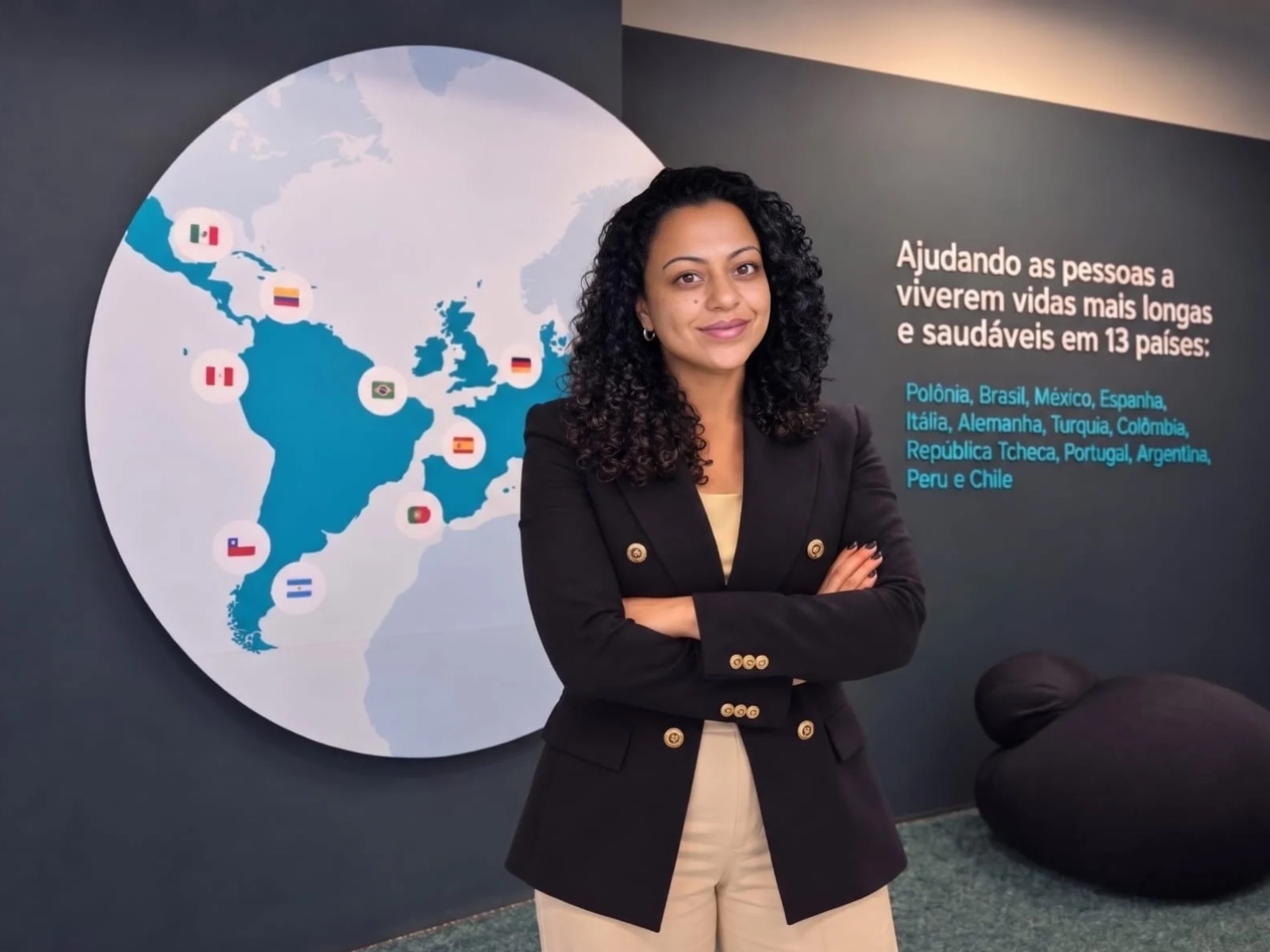
Over her five-year tenure at Doctoralia, Jayne Alcon has established herself as a key driver of sales excellence and operational quality. Starting her career in Customer Success, Jayne developed a deep understanding of post-sale customer value before transitioning into sales leadership, where she now serves as Sales Coordinator at Doctoralia Chile. Her unique background allows her to bridge the gap between top-of-funnel acquisition and long-term retention, ensuring that sales velocity never comes at the expense of deal quality.
In this interview, Jayne outlines her best practices for aligning sales execution with Ideal Customer Profile (ICP) standards, structuring weekly 1-on-1 coaching rituals, and eliminating the end-of-month sales rush. She also discusses how adopting Harmony transformed Doctoralia's sales management, replacing archaic manual call audits with 100% automated conversation visibility that empowers sellers to self-coach and drives daily management efficiency.
You started in Customer Success and then transitioned into sales, earning new leadership positions along the way. To kick off on operations: what signals do you usually look for to understand whether an operation is truly being successful or not?
Jayne Alcon: Being able to differentiate between CS and sales comes down to understanding the bigger picture. In sales, I always start with the funnel. At each stage, I can analyze both what the individual seller persona is doing and how the overall machine is performing.
As a leader, my goal is to figure out if the team is performing consistently, or are they just getting better-quality leads this week? So I'm constantly looking at the funnel, conversion rates, incoming lead quality, and team productivity.
Having that CS background allows me to understand how customers behave post-sale, while my frontline sales role shows me how the journey starts and who our Ideal Customer Profile (ICP) really should be.
Looking at the full picture helps immensely. I analyze top-down, lead quality and top-of-funnel conversion first, and then dive into individual daily execution. For example, today is pipeline review day with the sellers. We sit down and analyze everything: lead volume received, open opportunities, deal progression, and our sales SLA to ensure we cover the whole pipeline throughout the week.
As a sales leader, you have to balance many competing demands, targets, conversion rates, but also making sure incoming clients fit the ICP. What best practices do you follow here?
Jayne Alcon: ICP alignment is essential. Looking at the post-sale stage is crucial, but identifying the right customer before closing the deal is paramount. If I sell to a profile that doesn't align with our solution, they won't have a good experience, and it won't be good for the company either. Working in healthcare, it directly impacts the care of potential patients.
Today, we carefully analyze what type of practitioner we should work with, what value we want to deliver as a company, and how the team can spot those traits. Selling just for the sake of selling is easy, but the downstream problems it creates, especially for CS and retention teams, are massive.
Focusing on the right specialists allows us to maintain healthy retention and turn those clients into brand advocates who generate organic referrals. Our guiding principle is: the customer might want to buy, but will they actually get results? Selling just to hit a quota backfires, because one dissatisfied client spreads negative feedback to many. On the other hand, bringing in the right customer creates a brand advocate, which is far more valuable.
Let's talk about training and coaching now. A major mission for any sales leader is helping the team develop professionally, not just in hard sales skills, but in soft skills as well. What best practices do you adopt in your coaching?
Jayne Alcon: Training has always been a passion of mine. Even back when I was an analyst, I loved diving deep into process manuals. They are incredibly useful, especially for new hires joining the team. When someone starts, they have to absorb the company culture, understand the product, and get to know the team all at once.
Having a clear step-by-step guide makes onboarding much smoother. During my earlier days at Doctoralia, I worked heavily on this; training is key, and it's something I genuinely enjoy doing. That naturally aligned with leadership. In fact, when leadership opportunities were brought up to me, my primary skill was training people and delivering a robust, comprehensive onboarding experience.
In sales, we always start with the fundamentals. They need to understand how SDRs operate and how Doctoralia integrates with other systems. If we use CRM platforms, sellers must have every supporting tool at their fingertips alongside foundational product knowledge. We don't just rely on long training sessions; we share bite-sized learning pills during daily standups to respect their time. We moved away from the mindset that "sellers should only sell and never have their calendars blocked." Sellers need continuous enablement and updates. At least once a week, during a daily or checkout meeting, we analyze a specific call or topic together. We run group feedback sessions as well as 1-on-1 reviews where reps can evaluate what went well and what can be improved. Training makes sellers feel confident. A seller who enters a meeting feeling confident is 95% of the way to closing that deal.
Looking at sales performance, some sellers experience performance spikes while others deliver consistent results month after month. What behaviors and skills do you observe in those consistently top-performing sellers?
Jayne Alcon: Structured training makes it much easier to analyze overall performance. If certain reps deliver consistently, it proves that the target is achievable for the whole team. I like to segment by seniority, but also by tenure within the company. For instance, we have junior, mid-level, and senior sellers. However, a senior rep might have been with us for less than a year, while a junior rep has been here over a year. The senior rep's challenges are usually product or company-specific, rather than running a SPIN selling framework or SDR discovery call.
My goal is to pinpoint whether a bottleneck is an individual skill gap or a structural issue. To do this, I rely heavily on Harmony. It allows me to break down the workflow. Is the team connecting and holding initial conversations with the right pitch? And secondly: are they conducting a thorough SPIN diagnosis and closing deals consistently? I look at these two levers. If targets aren't being met, where is the breakdown happening, at the top or the bottom of the funnel?
This helps differentiate reps who deliver consistently from those with volatile performance spikes. I analyze each rep individually during weekly check-ins to spot gaps and correct them. One key practice we implemented was breaking the habit of rushing in the last two weeks of the month. We train the team to accelerate from day one, so by mid-month they've already hit around 60% of their quota, allowing them to close the month calmly and predictably. Reps with strong product and process foundations handle this much better. We separate individual skill gaps from lead quality issues or market conditions.
In your view, what defines an "outlier" seller?
Jayne Alcon: I focus heavily on individual mastery. To me, a great seller is first and foremost a great listener. They must listen to the client, uncover their true pain points, and articulate our platform's value to close the deal cleanly. I'm cautious of setups where reps constantly depend on a colleague to rescue their deals. I work with reps individually so everyone can hit their own quota independently, balancing performance across the board rather than relying on two star performers carrying the load.
Here at Doctoralia's office, we have our five core values displayed on the wall: "Focus on results," "Keep it simple, keep it lean," "Develop yourself and stay curious," "Think like an owner," and "Radical honesty and respect." How do you keep these values alive in daily sales operations?
Jayne Alcon: Culture is foundational. A talented seller without cultural alignment won't succeed here long-term. Focusing on company values builds a resilient team. I participate in onboarding sessions with new hires, and the value I emphasize most is curiosity. Be genuinely curious about everything: understand the customer, their origin, their pain points, and own your operation like a founder. Working in a culture that sustains itself over time is far more rewarding than focusing purely on short-term sales metrics.
What did conversation quality monitoring look like before Harmony, and how did that process change?
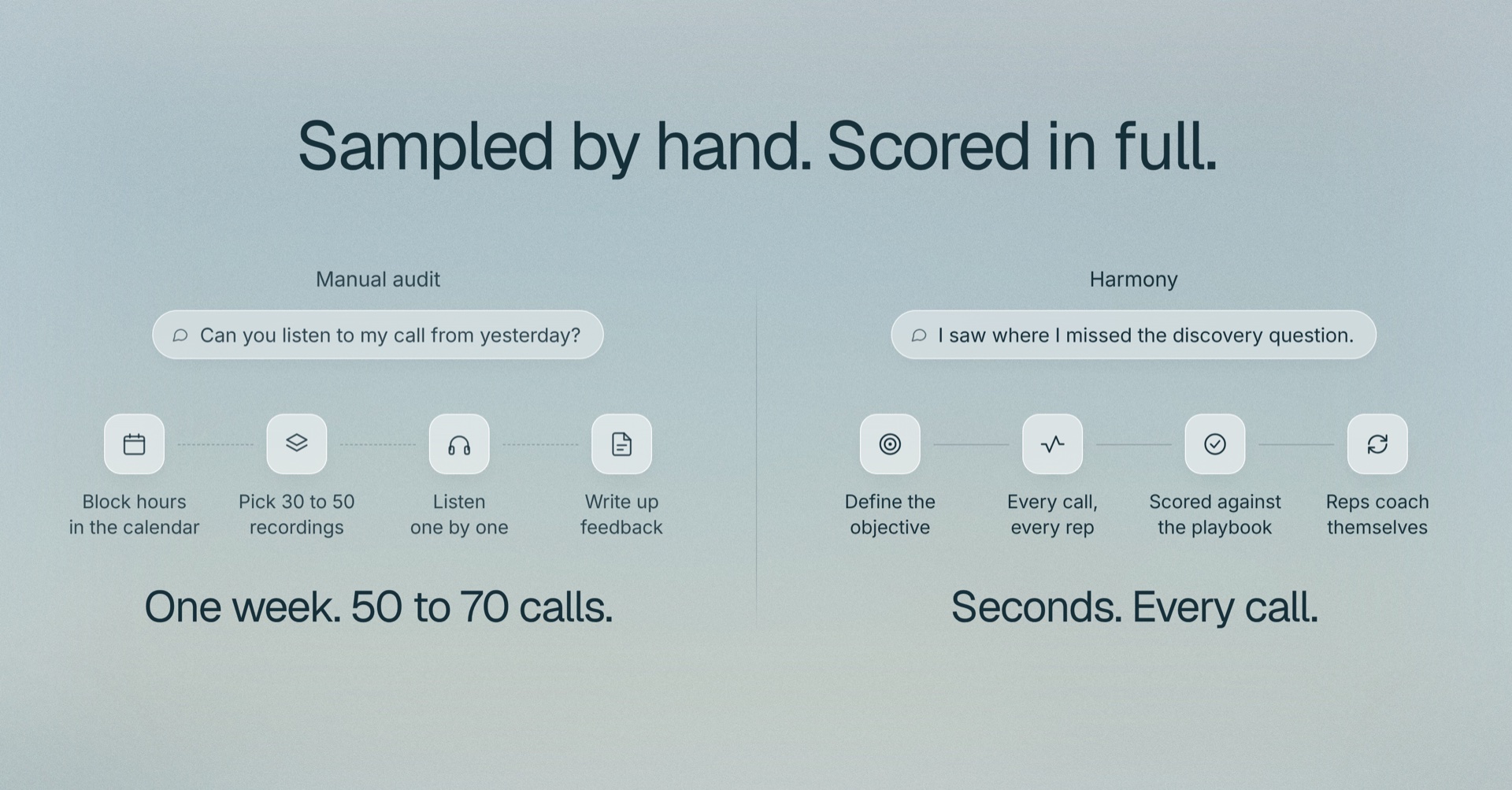
Jayne Alcon: It makes me laugh just thinking about how archaic and prehistoric our process used to be! When we felt something was off with SDR outreach or sales demos, a manager had to block hours on their calendar, manually pick 30, 40, or 50 call recordings, listen to them one by one, take manual notes, and then schedule feedback sessions.
That might work for a tiny team with low call volume, but when you receive 1,000 to 2,000 leads a month across a large sales team, manual sampling becomes completely unfeasible. You end up with huge blind spots. For instance, when I took over the team, sellers insisted: "Prospects don't want to talk to us; lead quality is terrible." We manually sampled calls over two or three days and indeed found calls where prospects said they weren't interested. In a full week of manual auditing, we managed to review maybe 50 to 70 calls.
Then, on a Friday, our COO introduced Harmony to us. He ran an automated analysis covering calls from June 15th to June 18th across all reps, categorizing the main objections, customer responses, and rep behavior instantly. I was sitting there with my tiny, manual sample of under 100 calls, while Harmony gave us complete, objective visibility across thousands of interactions in seconds! We immediately shifted from guesswork and small samples to total operational reality. Instead of spending days trying to find out what was happening, I could instantly focus on how to fix it. Harmony gives me objective data grounded in customized rubrics, so feedback isn't seen as just my personal opinion. It empowers management and dramatically accelerates rep development.
How would you navigate an audit if I gave you 1,000 call recordings today using Harmony? What steps would you take?
Jayne Alcon: With Harmony, it's seamless because it integrates directly with our existing CRM and call tools, no manual data uploads required. First, I define my objective: do I want to audit initial SDR discovery calls to see how leads are handled and whether reps use the right pitch? Or do I want to audit full product demos to check SPIN execution and value presentation?
Harmony categorizes and scores these instantly. Recently, a colleague and I were discussing an operational roadblock. Manually, you listen to a call looking for one specific issue. Harmony not only flags that issue, but uncovers three other critical process gaps you hadn't even thought to look for.
If you were sitting down with another sales coordinator or manager today, what strategic advice would you share with them, and how would you define Harmony in a single sentence?
Jayne Alcon: Working with Harmony shifts your focus from searching for problems to actually solving them. I stopped putting on headphones to manually sample calls and started using Harmony to analyze the full picture. Who are my top performers? What are they doing differently? Where are deals dropping off in the pitch? It elevates you from basic sales enablement to high-impact strategic management. It also drives rep autonomy. Reps no longer ask me, "Can you listen to my call from yesterday?" Instead, they check Harmony themselves, review their AI scorecard, spot where they missed a discovery question, and adjust their pitch for the next call independently.
In a single sentence, I would define Harmony as "daily management efficiency."
What are your personal best practices for continuous professional development? How do you stay sharp and learn from peers?
Jayne Alcon: I love connecting with people and understanding different perspectives. At Doctoralia, someone once told me during my interview process, "We are all just one Slack message away." Whenever I face a challenge, I reach out to peers across different departments and regions, Brazil, Chile, Colombia, Mexico, Spain, to exchange benchmarks and see how they solve similar problems.
I also take specialized courses and work with mentors who guide my career transitions, from CS analyst to supervisor, and now coordinator. I always tell new hires never to be afraid to ask questions or seek help. Curiosity is one of our core values, and I take full advantage of Doctoralia's collaborative culture to keep growing.