Leadership, Culture, and Conversational Intelligence: An Interview with Eduardo Villares, Head of CX and CS at Cruzeiro do Sul
Discover business and leadership insights from an executive who has led hundreds of customer service operations across different industries and now leverages Harmony and AI to gain faster business insights, accelerate decision-making, and scale results.
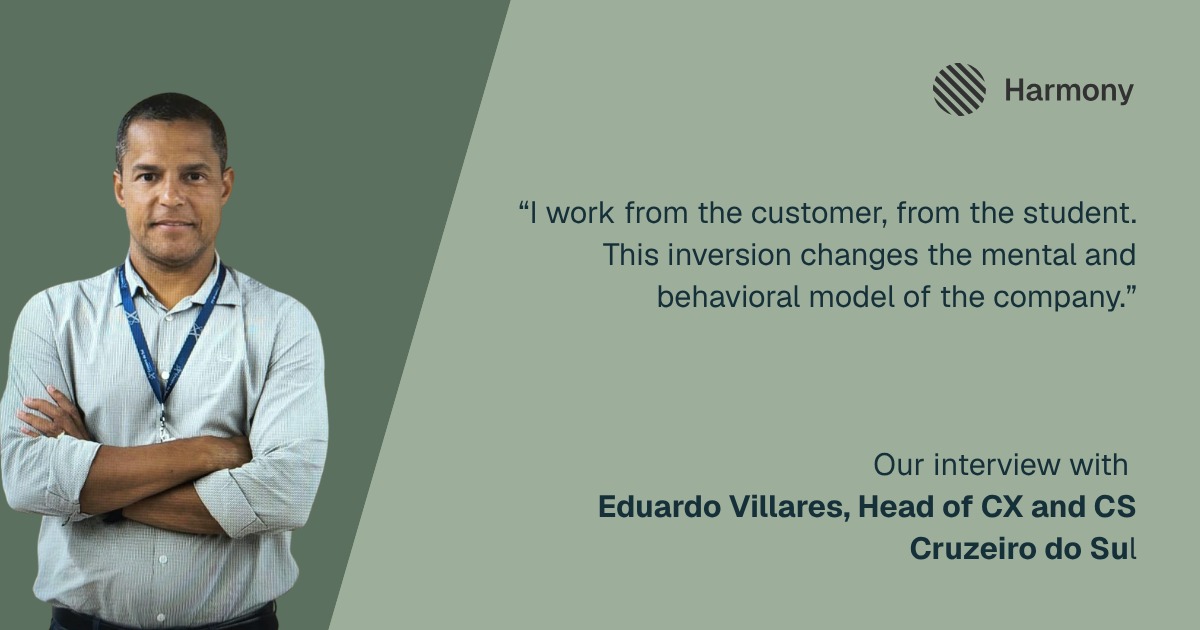
With a solid professional career spanning over 20 years, Eduardo Villares is currently the Head of Customer Experience (CX) and Customer Success (CS) at Cruzeiro do Sul, a Brazilian higher education group. Throughout his career, Villares has accumulated experience leading hundreds of customer service operations and implementing operational structures, working in highly dynamic and regulated sectors such as telecommunications, insurance, and education.
In this exclusive interview, Eduardo shares his strategic vision on customer experience-driven management (working backwards), the role of cultural alignment and employee autonomy in leading teams at any scale, and how Harmony's conversational intelligence transformed operational diagnostics and efficiency at Cruzeiro do Sul.
You have a career spanning over two decades leading hundreds of operations across the country. To kick things off, what's something most CX leaders believe is important, but in your experience actually doesn't move customer experience very much?
Eduardo Villares: As a CS leader, I have had the opportunity to lead over 400 customer service operations over the last 20 years. I've had the chance to implement many customer service operations across all of Brazil. And what I have is a slightly different vision, I work backwards when I think about CX and CS.
But I'll stop here and first contextualize what CX is and what CS is. Many people confuse these concepts. I think it is fundamental and this is very clear to everyone. CX thinks about the entire chain, relationship, and student experience as a whole, from the moment they enroll until they complete the course, and beyond that, it encompasses everything surrounding the student when they think about the brand and the experience they had throughout that journey. So here we are concerned from the moment they enroll until they complete the course.
I think that's a very important distinction. It's very important because people confuse them. When we talk about CX, we are concerned with CSAT and NPS, which are metrics that directly measure student satisfaction, engagement, and reflection on the experience they had with our brand. When we talk about CS, we are concerned with LTV, churn, and retention theory. So these are different concepts that complement each other and allow us to offer an excellent experience to the student, to the point where they become a promoter of our brand.
So I think it's fundamental to clarify this before answering your question. Given that this is clear, I have a slightly different view that starts working backwards. First, before thinking about a process and designing it to make it happen in practice, I think about the following: what is the experience I want to provide to my student? From the moment I have a crystal-clear idea of the experience I want to provide to my student, I look inside, I look into the company's internal ecosystem and ask: what do I need from IT to offer this? What do I need from Finance to offer this? What do I need from Legal to offer this?
So many people work from the process to the student or from the process to the customer. In my management style, I do the opposite: I work from the customer, from the student, backwards. And this inversion changes the mental and behavioral model of the company. You echo the voice of the student throughout the entire system you participate in.
So what I do differently is exactly that: first, I focus on the student's experience. If a student contacts me regarding an issue with payment processing, instead of thinking about what process I need to have to process that payment, I think about what the best experience for the student regarding payment processing should be. If they pay via Pix, it settles instantly. If they pay via invoice, it settles the same day, assuming that to be true. With that scope very clear and all the experience I want to provide defined, I tell IT: I don't need 48 hours, I need 24, because my student's experience requires it to be 24. And so I build this ecosystem backwards.
In your career, you've managed customer operations ranging from dozens to thousands of people. What's one management practice that works at 50 people but completely breaks at 500 or 3,000?
Eduardo Villares: Honestly, I've had the opportunity to lead engineering departments, customer service operations, and field operations. I've had the opportunity to work in marketing, customer acquisition, customer monetization, and customer retention. I've worked in sales implementing new sales sites, in customer service as an operations manager, planning manager, and project manager. That is, I've worked across insurance, telecommunications, and now education markets.
Answering your question about the difference between leading a small team or a very large team: to me, when it comes to leadership, three strategic pillars must be crystal clear.
First: the strategy must be clear from the CEO down to the young apprentice. That is point number one and it is fundamental. Regardless of your team size, whether you have five employees or ten thousand employees, the strategy must be clear from the top of the funnel to the last mile.
Second point: you must not only ask people to do things, but ignite in them the desire to want to do them. It's about showing them the importance of that impact on your directorate, your ecosystem, the company, and the customer experience. And for that to happen, you have to give the team autonomy.
And third: you have to cascade the company's governance model and core OKRs into your daily work routine. So you understand what the company wants in terms of strategic pillars and OKRs, and cascade that into the governance model so your team, regardless of size, is capable of making it happen. That cascading must be part of their day-to-day routine.
So for me, whether I have a team of 10 people, 400 people, or 7,000 people, the mental model must be the same, and the culture permeating all people must be the same, and then size becomes merely a characteristic, provided the strategic cascading and necessary alignments are made.
It is more complex to lead larger teams in terms of presence and proximity. That undoubtedly requires more investment and energy to stay close to them. What matters is having purpose clear, expectations clear, strategic cascading clear, and making it happen by giving autonomy, freedom, and above all, instead of managing by demanding results, what I've learned over these years of my career is: I will work to foster a favorable work environment.
And that environment awakens in people the desire to do what needs to be done. It's a slightly different approach, but it works very well. Instead of being a manager who micromanages, demands results, and tracks deliverables, I make a point of being close to my team and ensuring they have a favorable environment to execute what they think, a favorable environment to make mistakes. And it's totally fine to make mistakes, if you want to innovate without making mistakes, you're probably a genius, and I am far from that, because all innovation requires it.
So my management style, whether for ten people or a thousand people, is to maintain a favorable environment so employees feel empowered to have autonomy and do what they want to do without fear of cause and consequence if things go wrong. To me, that is the difference and the major evolution I've had over all these years working in this field. I didn't think this way ten years ago. It happened over time, learning from my mistakes, and today my management style makes me realize that, of everything I've experienced, this is the best model.
Many companies invest significant amounts in training to build a Customer-Centric culture, but the learnings end up getting lost in the daily routine. What makes training truly effective and capable of transforming daily practice? What actually changes frontline behavior?
Eduardo Villares: I've experienced a few different scenarios when it comes to training. First, I'll contextualize the scenarios and then share my conclusion.
Scenario 1: I attended fantastic training that blew my mind. But when I returned to my work routine, the routine consumed me to the point where I couldn't apply what sparked my enthusiasm. Scenario 2: I was in training and thought, 'Man, it makes zero sense for me to be here. The company is investing time and energy in this and it won't help us improve results'. And Scenario 3: I went in with very low expectations and thought, 'Wow, I'm going to take this with me for life'.
Through Test & Learn and my learnings, I created a routine and set aside time within it to ask: what will I apply in my day to learn what just blew my mind in this training so I can execute it daily?
I'll give you an example: about 20 years ago, as an engineer by background, I was invited to participate in a Six Sigma Green Belt project. I went in with zero expectations and saw a very interesting methodology for managing projects. I still use Six Sigma today. I later completed the Green Belt, Black Belt, and Master Black Belt because I blocked time on my calendar to ensure it was important and that company culture and commitments wouldn't consume me to the point of forgetting. When you learn that, there's a key turning point, because everything that sparked your attention and desire to do, you actually execute. You don't let it become just another training session.
Nowadays, when I think about training, before attending I ask: what is the goal of this training? What does the company expect of me? What expectations am I setting? What will I do to prepare? And finally, what will I apply from this in my day-to-day or my employees' day-to-day so it creates a real effect in our routine?
I strongly believe in training. For example, today when looking at AI trends: you consider AI to increase employee productivity, for information security and data protection, to improve customer experience, and to optimize operational routines. All of that requires training. Nobody is born knowing how to work with LLMs, build agents, or manage cloud projects. Training with that focus, knowing exactly what it's for and the impact it will bring, is fundamental and represents 80% of the journey. If it's just to attend another generic training, you're likely throwing away a great growth opportunity.
When you take over a new CX or customer service operation, what are the first three things you look at to understand whether it's actually healthy?
Eduardo Villares: That's a great question. I have a mental framework that leads me down two distinct paths during my first 90 days at a company, which I jokingly call 'GPS': People (Gente), Processes, and Systems.
On Path A, I seek to understand:
Processes: What are the main offending processes that directly impact customer or student experience? I won't change the world in 90 days, but I can understand the root cause of key problems and create governance routines to dive into them and fix them. It's intensive mapping.
Systems: Systems must be our allies, not enemies. I map the architecture to answer: does this system prevent me from making mistakes? Does it alert the employee if there is an error? Does it support the company's 2 to 3-year strategic plan or does it need improvements and integrations?
People: I need the best people in the right places. I can't ask a fish to climb a tree. I hold 1-on-1 conversations with employees and ask four questions:
- What are we doing well that we must keep doing?
- What are we doing well that, if done slightly differently, would yield even better results?
- What are we doing that isn't good and needs to stop right now?
- How can I help you with all of this?
When I have this true picture of people, processes, bottlenecks, and systems, within the first 90 days I get an initial snapshot of what the company needs to do.
On Path B, I conduct strategic alignment with executive leadership (CEO, VPs), my peers, and my team:
With executive leadership, I ask: 'What is keeping you up at night that is part of company strategy and that CX/CS can help solve?' I take that and cascade it into my governance model and OKRs.
With peers, I understand their pain points and build partnerships.
With my team, I map bottlenecks and create a medium-to-long-term plan, aligning realistic expectations and timelines. If a process takes 5 weeks to fix, I communicate that clearly. Difficult conversations and expectation alignment must happen.
At the end of 90 days, you look back, deliver quick wins, and validate with everyone whether the medium-and-long-term strategic plan aligns with company pain points. If everything is aligned, we go live and make it happen.
Could you share a practical case from your career where you faced unsatisfactory satisfaction or retention metrics and structured a successful action plan to turn the game around?
Eduardo Villares: We could stay here for two hours remembering stories, but two cases stand out to me and won awards.
The first was about 10 years ago when I managed 3,000 customer service positions at Oi B2C, covering 10 million landline subscribers, 5 million Velox broadband users, and 1 million TV subscribers, operated by two partner vendors. Our operational metrics were terrible: we had over 10 Anatel regulatory complaints per 1,000 customers (acceptable was 1), a satisfaction score of 5.5/10, over 20% repeat calls within 24 hours, and a negative NPS. To top it off, the vendor financial model was fixed per Attendant Position (PA), which encouraged neither competition nor quality improvement.
What did I do? I opened a market tender and brought in 4 new vendor partners, expanding from 2 to 6 partners. I changed the compensation model: I would no longer pay per fixed PA, but per call handled with quality. If a customer called back within 24 hours, I didn't pay for the second call, and the vendor had to handle them again. Furthermore, I created a competitive model where the 'judge' of the battle was the customer evaluating the call at the end.
As a result, we migrated traffic away from underperforming players toward new partners delivering high performance at a lower unit cost per call. Result: we cut R$ 20 million in costs over 18 months, satisfaction scores rose to 8.5, Anatel complaints dropped to 2 per thousand, and we went to Las Vegas to receive the Call Center World award.
The second case is the "Taking Care of the Customer" Program, driven by passion. We realized customer service reps navigate 10 to 20 different screens and we often demand magic from them without caring for them first. We blocked the schedules of all 3,000 assistants over a year for a special program. On day one, we pulled operators off the lines to watch a movie in a cinema with popcorn, discussing empathy and the importance of putting oneself in the customer's shoes. We had deep dynamics encouraging employees to call loved ones, some reconnected with parents after 10 years. On day two, we hired hairstylists, makeup artists, and barbers to take care of their look right on site.
The result was an explosion in quality metrics: satisfaction jumped to 8.5, it became a benchmark case, and we won an award from IBRC (Instituto Ibero-Brasileiro de Relacionamento com o Cliente). When we take care of employees, they gain empathy and a genuine desire to care for customers.
Having worked across sectors like telecommunications, insurance, and now education, what changes in these industry dynamics, and what remains constant as a universal pillar of CX/CS?
Eduardo Villares: Markets are different and customer behavior models are different.
Telecommunications teaches you to be fast. If you delay reacting to a competitor's prepaid offer, you lose 300,000 to 400,000 customers in a week.
Insurance, being highly regulated, teaches you to be qualitative and process-impeccable.
Education moves me through purpose. Only 16% of the population in Brazil has access to higher education, and I strongly believe we only change lives through education.
Now, regardless of the market, what remains universal is: placing the student, customer at the center. It's waking up every day and asking: 'What will I do to improve my customer's life today? What can I provoke in my company to improve?' If you improve 1% every day, by the end of a year you evolve 37 times in efficiency. Regardless of the sector, what matters is consistency and the positive memory you leave in the customer's mind about your brand.
If I gave you 1,000 customer conversations from a company you've never seen before, what would you look for first to understand what's really going wrong in that business?
Eduardo Villares: First, it would take far too long. I come from an era where we hired quality monitoring services demanding 4 call audits per month per operator, which was painful because getting a diagnostic took forever. And if we asked any question outside that standard report, we had to reprocess everything from scratch.
Today, I receive about 5 to 6 technology vendor proposals per month. Having a tool that impacts my productivity, shares my mental model, and can permeate 1,000 calls is transformative. It gives me speed and ensures I don't miss strategic opportunities. In manual analysis, I would certainly miss major insights due to lack of operational processing capacity. Conversational intelligence allows reprocessing recordings using natural language and delivers precise answers in minutes.
How was Harmony introduced at Cruzeiro do Sul, and what kind of strategic and operational decisions has the tool enabled in the team's daily routine?
Eduardo Villares: The Harmony case is curious because it was previously tested by a former employee who hadn't realized its full potential. When I took over, I asked to talk with them, understood the possibilities, and proposed starting over from scratch.
I delimited 5 operations for a pilot with 20 licenses: loyalty/re-enrollment, retention, returning students, Reclame Aqui (complaints), and sales. When we realized the value generated, we expanded from 20 to 100 licenses, covering 50% of my operation.
To answer pragmatically, Harmony provides invaluable outputs, especially in sales operations:
Wrong Sale: The tool alerts us within 20 minutes if a student requested Course A and the salesperson enrolled them in Course B. Knowing this quickly, we reach out, apologize, fix the enrollment, and prevent an early churn of a student with a high Customer Acquisition Cost (CAC).
Improper Sale: We identify if a salesperson pushed an unsolicited sale. We listen to the call, cancel the enrollment without friction, and apply a balance of consequences with the rep.
Churn Probability: The tool highlights calls where the rep failed to clarify questions about student financing. We call the candidate, resolve the query, and mitigate churn.
Top Seller Modeling: We identify the speech patterns of top-converting reps, map how they overcome objections, and turn that into training checklists for the entire sales team.
Furthermore, we elevated our management baseline: before, it took weeks to get an incomplete diagnostic. Now, in natural language, I ask Harmony to reprocess recordings and in 20 minutes I have the diagnostic ready. My problem before was not having a diagnostic; now my focus is having execution traction on the actions diagnostics reveal. The pilot runs through November, and maintaining this pace of facts and data, we will roll out to all operations.
If you had to summarize Harmony in a few words for another CX, CS, or Sales executive, how would you define it?
Eduardo Villares: Friend. Harmony is a friend that you'll be glad to have by your side, because it will save you time, save you energy, increase your productivity, and give you a very broad and, at the same time, very specific view of what's happening in your operation, without costing you much. And when I say 'costing,' I mean in terms of time and energy. So, look at Harmony as a friend, because today it's adding a lot of value for me.
In closing, imagine someone becomes Head of CX tomorrow for the first time. What's one ritual you would tell them to introduce immediately?
Eduardo Villares: The beauty of CX/CS is learning every single day. I recommend a few books and concepts that have shaped my perspective:
- Customer Obsession, by Colin Bryar and Bill Carr (Amazon): essential reading for understanding what it means to put the customer at the center of every decision.
- Everyone Is Incompetent, Including You, by Laurence J. Peter and Raymond Hull: an excellent book exploring how people can reach their level of incompetence when promoted without adequate preparation, encouraging critical reflection on leadership and professional development.
- Big Dream, by Cristiane Correa: a remarkable book that offers a fresh perspective on management, leadership, and building relationships with people.
- PIE Methodology (Performance, Image, and Exposure), by Harvey J. Coleman: early in your career, Performance is essential, as it reflects your ability to deliver results and demonstrate technical competence. However, to advance into more senior executive roles, you also need to develop your Image and Exposure: how you are perceived professionally and the visibility you build within the organization. Relationships are essential and go far beyond technical expertise.
I leave these tips so everyone can take the next step in their career.